
No Shelter in Birnam Wood: Silver Spring Stage’s Macbeth Makes Familiar Bloodshed Newly Unsettling, Even When the Dramatic Exchanges Need Sharpening

Updated: 5 days ago

Hot Take
“Methought I heard a voice cry ‘Sleep no more! Macbeth does murder sleep…” (Act 2, Scene 2)
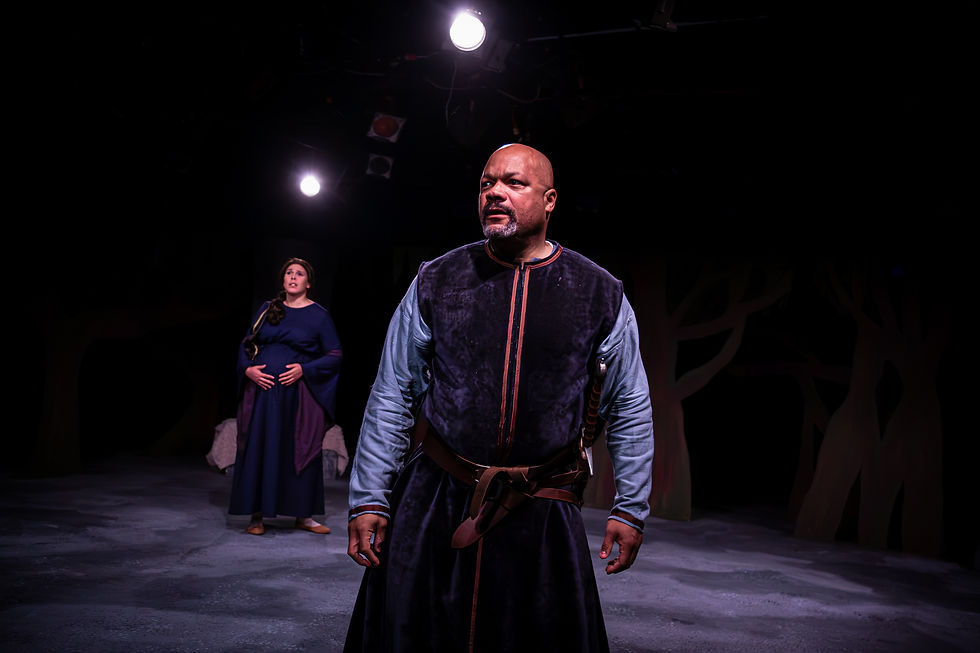
Silver Spring Stage’s Macbeth, directed by Madeleine Smith, summons up a new incarnation of Shakespeare’s short, brutal, much-beloved Scottish play set entirely in the shadow of Birnam Wood, where the bare suggestions of interiors—a bench, a table—offer almost nothing approaching shelter. Safety itself has been destroyed by the famous regicide committed by Lord and Lady Macbeth and this production wants to press the horror of a world where safety has been lost into the hearts of its audience.In its best moments, Smith’s Macbeth is freshly horrific, with a trio of Wyrd Sisters (Katherine Leiden, Tara Scully, and Stephanie Dorius) and a towering Hecate (Erica Irving) orchestrating a plot of bloody destruction for almost everyone involved—man, woman, and child. Director Smith leaves Silver Spring Stage’s blackbox stage remarkably bare, with stark layers of trees providing an unchanging backdrop for the action. Instead of elaborate set design, Smith’s Macbeth is brought to vivid life by significant sound design (MaeAnn Ross), careful and precise lighting design (Sam Lincoln), and an incredible collection of medieval costumes (Nathaniel Cavin, James Hoobler, Nora Galil) that decks the characters in rich reds and greens and resplendent expanses of honest-to-God chainmail.
Smith leans into the violence and fear of the story, enlarging the menace and power of the supernatural forces inside it as well as the emergent viciousness of Macbeth himself. She also inserts a few deliberate anachronisms as a way to draw parallels to our current moment, parallels she draws out in her director’s note. How much those parallels resonate will vary with the viewer, but I appreciated the immediacy and power of the dread that comes when everything that once seemed sure seems able to crumble with terrifying swiftness.
The fundamental story of Macbeth is also a procedural: once the prophecy sparks the plot, it becomes tremendously important to follow the electric paths of who knows what and when. This production too often lets crucial revelations pass without showing how they change what the characters think, feel, or choose to do. Masters like Agatha Christie and Alfred Hitchcock made this suspense their bread and butter; I wish Smith’s Macbeth had been able to produce similar crackle.
Deep in the Woods
The three witches are a highlight of this production, inhabiting with menace and swagger not just their traditional roles, but almost all the incidental roles of the play, acting as cutthroats, servants, and more. Their initial appearance, in which they savagely murder a trio of wounded soldiers on the field of the play’s opening battle, is certainly the most exciting and frightening way I have ever seen them join the action.
The supporting cast of the play is strong, with particular standouts. Ryan Gihuly’s Angus has an arresting voice and brings vivid life to his lines following the opening battle. J.R. Hontz, first as Duncan and then the Porter, brings an essential regal quality to his doomed king and a delightful mirth to the comic Porter, who jokes about Donald Trump and the effect of drinking on sexual performance right in the midst of Shakespeare’s carnage. (Can you believe the Porter is often cut from performances of Macbeth? There ought to be a law.)
One of the most awful parts of the play, the murder of Lady Macduff (Erica Irving) and her daughter, is impressively and bravely dark. Irving’s Lady Macduff sees her fate far too clearly to face it with almost anything but bitterness. Her daughter, played by Zaina A.—a third-grade girl—is heart-wrenchingly vulnerable. She delivers her dialogue with admirable sang-froid even if she is, unfortunately, impossible to hear once positioned farther upstage. But the fact that this production has her and her mother murdered evocatively on stage together is daring, refreshing, and utterly horrible. Lady Macduff’s death, too, is performed with merciless intensity by Irving. It is then completed with a decidedly un-Shakespearean utterance, by her murderer, of “fucking bitch.”I didn’t know, in the moment, whether I liked that choice, that deliberate and flagrant anachronism, but it has stuck with me. Does Shakespeare really need that interjection? It felt cruel. Crass. Maybe it was one of my favorite parts.
Princess Malcolm—the gender-swapped heir to the murdered Duncan—is played with vigor and credibility by Irene Denniston. She establishes her bona fides as a leader and a person with an ounce of common sense by immediately perceiving the danger to herself and getting the hell out of Dodge, thus saving her life and ultimately the kingdom.

Partners in Ambition
Lady Macbeth (Maura Suilebhan) is a captivating and remarkably human figure as the first person to transform the strange prophecy of the witches into an opportunity that could be seized by someone with the will and the wit to do so. If her husband lacks either, so be it: she will make up the lack. Suilebhan gives subtle, searching readings of Lady Macbeth’s claims about the natures of men and women and her ambiguous references to her own motherhood. She is fiery and passionate, but her half-checked motions also suggest thoughts she cannot quite bring herself to act on. As her husband unravels, she begins to discover that she cannot simply will away her own response to their crime.
Lord Macbeth (Matt Bannister) seems, initially, less a man of action than many of those around him. He appears bewildered not only by the prophecy but by the eagerness with which his wife turns it into a plan. His growth from reluctant regicide to bloodthirsty tyrant is portrayed with emerging snarls and vocal ferocity that certainly support his place as the story’s ultimate villain. I found it harder to believe in him as a warrior and a man of action, however. I also wished I could have seen more intense interest in those around him, more signs of listening and thinking; several times he stepped on important lines as he swept into what he was going to say.
When Revelation Doesn’t Register
The final confrontation between Macbeth and Macduff (Chris Holbert) illustrates the problem. When the two finally meet in battle, Macbeth begins by sharing that he has actively avoided Macduff because of his guilt over having had Macduff’s family murdered. Macduff refuses to discuss Macbeth’s crimes: his answer is his sword. The two fight, but Macbeth tells Macduff he is wasting his efforts: Macbeth cannot be killed by “one of woman born.” Macduff counters that he was “from his mother’s womb untimely ripped”—a legendary twist—and Macbeth, realizing that the prophecy has betrayed him, refuses to fight. Macduff demands that he surrender, promising to exhibit him as a public spectacle. Macbeth scorns that humiliation and chooses instead to fight to the death. But Bannister and Holbert too seldom let those discoveries change how they speak or move toward each other.
My hope is to show the information bouncing back and forth between the two men, how it affects their motivations, and how it hints at what they are thinking as multiple layers peel back during their confrontation. They pass ideas back and forth like a medicine ball, and it is essential in a performance to show the receiving, reacting, and the sending forth of those ideas.
Many scenes suffer from the same problem: when Duncan’s murder has been discovered and Macbeth, amid the clamor of trying to figure out what on earth happened, casually declares that he has himself killed the possible witnesses, the entire room ought to crackle with shock. But I wasn’t sure if anyone really noticed: it felt like everyone was locked into the scene, expecting it to proceed because that’s what scenes do.Similarly, in one of the most heart-wrenching scenes of the play, Ross (John Jones) arrives in the midst of Malcolm and Macduff’s conversation, and Macduff immediately asks whether his wife and children are safe. Ross (played by Jones with an appealing sensitivity) initially lies, unable to bring himself to state the truth. But Macduff presses him, finally getting him to reveal their murder. Jones and Holbert each play their parts well (Holbert has an excellent voice for Shakespeare, and portrays Macduff with aching warmth), but I really wanted more out of the transition. Why does Ross first lie? When does Macduff begin to realize that something is being held back? How does he figure out how to coax the truth out of Ross? There are so many questions, and answering them would help that scene crack open like a tree sundered by lightning when the truth is finally revealed.
The Blackbox Grit
I often find intimacy choreography at the community theater level to be too choreographed: there’s a sense of breaking from the normal action to take part in a small dance. Here, however, Lord and Lady Macbeth’s kissing and touching are fierce with urgency, their ambitions and desires meeting in ways that feel refreshingly real. Compliments to intimacy choreographer Bess Kaye, as, of course, to Bannister and Suilebhan.The fight choreography (also Bess Kaye) often feels perfunctory. Perhaps it’s churlish to complain: there is a lot of fighting in Macbeth, but much of it feels limp. There is a great deal of listless swinging in gentle arcs in the general vicinity of opponents. A brief exchange of sword practice between Banquo and Fleance (Hart Wood and Julian Dorius) feels particularly insubstantial: what are the reasons for that bit of swordplay? Is it a meaningful moment of father/son bonding? Is Banquo trying desperately to prepare his son for a dangerous future? Is his son excited to get the chance to duel or maybe surprised by his father’s unusual seriousness? I think the exchange could have been anchored by important bits of characterization.
There is almost constant sound design in the show and, by and large, I enjoyed it. MaeAnn Ross uses moving channels and melancholy drones and the cries of birds and soft, haunting melodies to create an atmosphere that works well with the dark, spare set. It is sometimes distracting, though, particularly in the dining scene with Banquo’s ghost (Hart Wood). The ghost himself, appearing with a vividly slashed neck, stalks Macbeth around the scene, emitting gasping vocalizations that are shiveringly (and delightfully) macabre. But there is a loud crackling sound effect that circles the space, possibly intended to correspond with the actions of the three witches who appear on stage, curling and bending their fingers as if manipulating the event. I couldn’t decide what the sound was supposed to be, beyond some indication that magic is at work, but it overpowers the performances.
Lighting designer Sam Lincoln creates one location, in particular, that I really loved: a place right next to the downstage pillar that anyone who has ever seen a play at Silver Spring Stage will know (and love or hate or both). Smith places a number of crucial scenes right there, and I thought it worked beautifully, feeling like a natural place of focus. When Lord and Lady Macbeth meet there after Duncan’s murder, their incarnadined hands shine to brilliant effect under the stark lighting.

The Verdict: GREEN LIGHT
Madeleine Smith’s Macbeth is absolutely worth seeing. It uses Silver Spring Stage’s gorgeous blackbox space to great effect and has the courage and ambition to chill and shock its audience in ways that feel both new and utterly appropriate to Macbeth and, while we’re at it, the Halloween season. The dramatic exchanges don’t always have the precision or force they need, but the strong supporting performances, tremendous costumes, and embrace of the danger at the story’s heart make this an exciting and memorable Macbeth.
The Details
Macbeth is a production by Silver Spring Stage and runs through November 15, 2026 at its blackbox theatre at 10145 Colesville Rd, Silver Spring, MD 20901. Written by William Shakespeare. Directed by Madeleine Smith. Running time is two hours and thirty minutes, with an intermission. Visit Silver Spring Stage’s website for information and tickets.


