
Sing in the Lifeboats: A Shattering, Mostly Seamless The Score at Shakespeare Theatre Company

Updated: 6 days ago
Hot Take
"Life is a shipwreck, but we must not forget to sing in the lifeboats."
—Oliver Cotton, The Score
Shakespeare Theatre Company's The Score is a production that knows what it is about and has the company to prove it. Brian Cox's Johann Sebastian Bach is the gravitational center of the evening, a tremendous and touching portrait of everything good about being a human artist. Around him, Stephen Hagan's Frederick II, a chorus of preening court composers, and a design that never stops moving make this one of the most satisfying nights of theatre the season has offered. There are a few bruises, but nothing that keeps it from landing.
The Man Who Couldn't Hold His Tongue
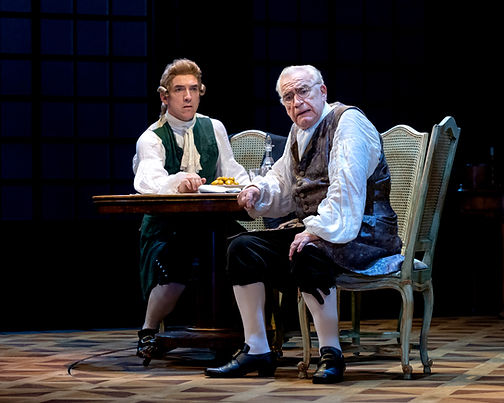
Cox plays Bach as a man constitutionally unable to watch injustice pass in silence. His physical comedy and vocal choices are so specific they become a character of their own, and his readings of Cotton's text are unexpected in the best way, never where you think a line is going. That is what lets the heavier material hit so hard. When Bach says, "As my eyes get worse, I seem to see more clearly," it arrives as a quiet observation and pays off as the evening's thesis, coming to fruition in the final moments when Jamie Wilkes's Carl says goodbye to his blind father. I was nearly in tears. Then there is Frederick. Hagan is a force of nature: the voice, the carriage, and the flamboyance are all big, deliberate choices, and none of them is hollow. The scenes between Cox and Hagan are touching, uncomfortable, and real. Frederick is an autocrat who makes every decision for his own glory, and it takes an artist to make him reconsider. Watching Frederick struggle against Frederick was sometimes painful, which is exactly the point. Their first meeting, in which the king walks in on Bach playing the harpsichord in his underclothes, is the evening's best introduction.

Fathers, Sons, and Fugues
Wilkes is vulnerable and honest as Carl, letting his character's failings rise to the surface when his extraordinarily gifted father arrives at court. When the wager comes, with Carl facing the court composers and the king himself over whether Bach can improvise a three-part fugue, the tension and stakes are palpable. The tenderness between Cox and Wilkes gives the play its beating heart.
The court composers, Matthew Romain, Christopher Staines, and Toby Webster, are a comic delight with fantastic chemistry. They swing between presentational, over-the-top fawning for the king and ruthless picking-apart of Carl, and the whiplash is hilarious. Peter De Jersey is a vivacious, fun-to-watch Voltaire, even if his French dialect wandered at times. His line, "too many bayonets, not enough books," got the knowing reaction it deserved in 2026.

The Women of The Score
Juliet Garricks' Emilia is one of the evening's great pleasures: a servant with a painful past and a heart of gold, whose kindness and devotion reveal the best of humanity. Her bond with Cox's Bach is devastatingly sweet. A moment of euphoria, as she hears Bach play in a church aisle conjured entirely from light, is pure theatrical magic.
Nicole Ansari-Cox, Cox's real-life wife, delivers a thundering monologue as Anna when she removes a Prussian soldier who has been terrorizing her town from her home. It shook the room. I only wish the production gave the Bachs more moments of close connection. The onstage marriage at times felt like it lacked the closeness that a partnership that long should radiate.
The play also puts sexual violence against women at the forefront. The discussion between the king and Bach about the rape of a town girl in Leipzig is powerful. It gives the play's themes of justice and of staying true to your ethics despite the consequences real teeth. Cotton's line, "It's the moment when one thing becomes another," captures what the evening does: it watches people become something else.

Turn the Table
Robert Jones's set is a clever machine. A turntable carries us between scenes, locations, and times, while elaborate flown-in pieces and backdrops keep the stage feeling alive. The transitions are never just transitions; they move the story forward. Jones's costumes are specific and beautifully made, and the props are masterfully used. Johanna Town's lighting is touching and effective, and Sophie Cotton's sound design is gorgeous and includes additional compositions.
The Blackbox Grit
Director Trevor Nunn's weaving together of the elements, themes, and stories here come tantalizingly close to the genius of Bach himself. The technical seams were small. One actor's entrance was so energetic it shook a flown-in door, and I could see a few bodies behind set pieces who shouldn't have been visible. In a show this immersive, such moments are easy to overlook, but they did peek through.
The Verdict: GREEN LIGHT
The Score is a timely telling of a story about what happens when power only serves itself, and of the artists and ordinary people who refuse to let it. It is about redemption, revisionist history, and justice, and it is also a great showcase for an ensemble. Go see it, and bring tissues.
The Details
The Score is playing at Shakespeare Theatre Company, September 11- October 25, at Harman Hall (610 F Street, NW). Written by Oliver Cotton. Directed by Trevor Nunn. Running time is 2 hours and 45 minutes with a 15ish minute intermission. Visit shakespearetheatre.org for information and tickets.


